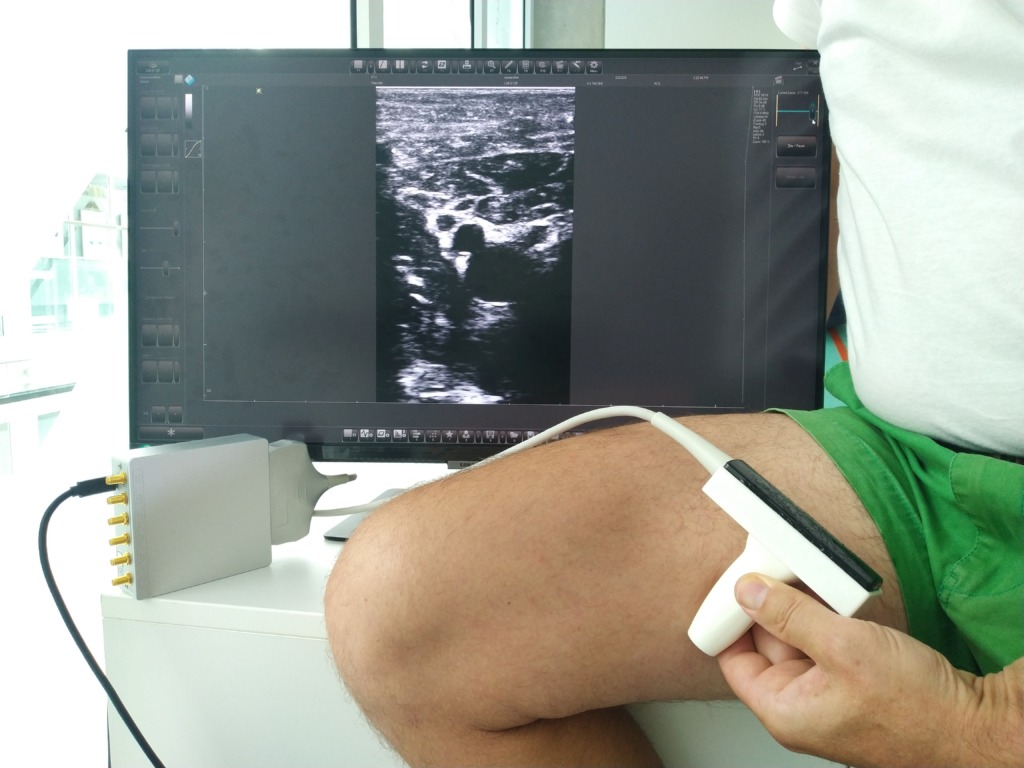
The project’s technical partners have delivered the portable ArtUScompact ultrasound beamformers and EchoWaveII imaging software (TELEMED), together with a low-profile, integration-ready ultrasonic imaging transducers (VERMON) featuring a detachable handle designed by KTU.
Study B will proceed in parallel with Clinical Study A, in which clinical researchers at four healthcare institutions are currently collecting compression ultrasonography datasets using a conventional protocol for deep vein thrombosis.
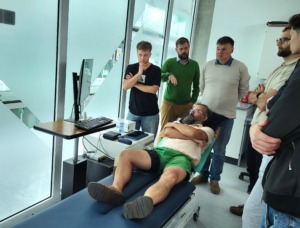
Further validation of the integrated ThrombUS+ system will comprise two clinical studies: an early feasibility study (C1), followed by a multicenter clinical trial (C2). Both studies will evaluate an autonomous compression ultrasonography comprising dedicated hardware modules, including a semirigid wearable tissue-compression device (ComfTech) and a pneumatic actuator controller (KTU). The system will be controlled through ATHENA integration software featuring a graphical user interface.
ThrombUS+ stands at the forefront of a revolution in medical diagnostics through the integration of biosignal processing and ultrasonic imaging. The project paves the way for a new era of disruptive diagnostics, in which artificial intelligence and ultra-portable or wearable technologies can help reduce the burden on healthcare professionals and enable continuous, autonomous point-of-care monitoring.
ThrombUS+ is supported by €9.5 million in funding from the Horizon Europe Innovation Action. Partners from eight European countries are developing an innovative wearable diagnostic device for point-of-care, operator-free, continuous monitoring of deep vein thrombosis (DVT). The project is led by Prof. Eleni Kaldoudi of the Athena Research Center and brings together partners from Greece, Lithuania, France, Germany, Italy, Finland, Spain, and the United Kingdom.
The ThrombUS+ project aims to develop a wearable ultrasound probe for continuous imaging of the lower-limb vasculature, including an innovative tissue-compression actuator required to perform compression imaging for DVT detection. The project also integrates electrical impedance plethysmography and light-reflection rheography to provide a robust suite of vascular assessment methods within a single autonomous wearable device.
DVT involves the formation of blood clots in the deep veins and poses a significant health risk, with potentially life-threatening consequences if left undetected. A substantial proportion of DVT cases may present without symptoms, making early diagnosis a significant challenge. The ThrombUS+ project seeks to address this gap by developing a user-friendly and accessible personal monitoring solution.
For more information, including updates on the project’s progress, please visit https://thrombus.eu.